Automate the financial, operational and reporting work you do today, grounded in your data, your processes and your ways of working. No code, and no waiting on Data or IT teams.
As seen at Accountex, ICAEW and FabCon Europe →Not "AI awareness". The specific, testable skills that decide whether an agent in your business produces work you can sign off, or a confident guess. Each pathway bundles its own courses, curated content and events, not just a reading list.
FDs, CFOs, heads of FP&A and data leaders deciding where AI goes next, and answerable when it goes wrong.
Analysts, BI developers and data engineers who'll build the deterministic layer everything stands on.
The person in the finance team who already builds things, and is about to become the one who builds this.

Each stage builds on the last. All of it free to start.
One form, under 60 seconds. Instant access to the recording and the interactive Excel-skills tutorial, with e-learning courses and your data & AI readiness roadmap included.
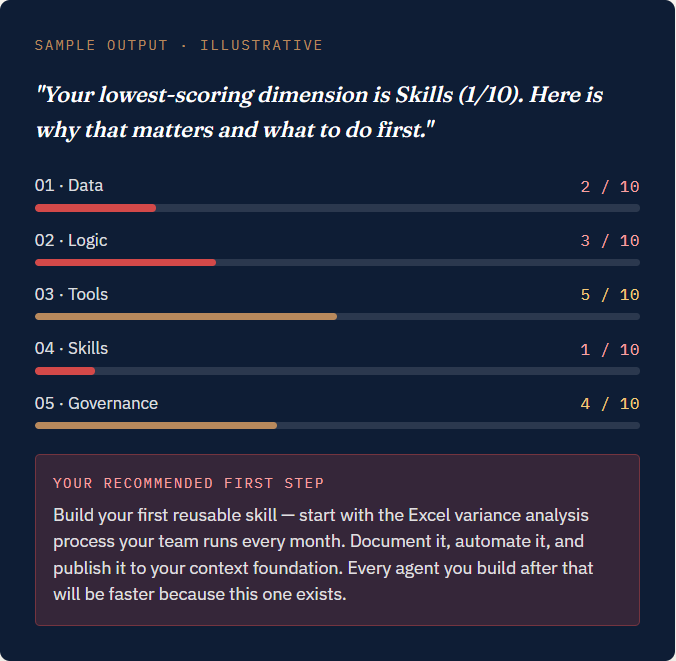
A short diagnostic across all five context layers. See exactly where your foundation is strong and where the gaps are.
Courses, community calls and member resources, structured around whichever of the three pathways above matches your role.
A hands-on build day in London. You leave with a working governed agent on your own data, not a prototype, not a demo.
The quarterly workshop above isn't hypothetical. Not theory from the sidelines, recognised expertise, applied in the field, alongside the people already building it.

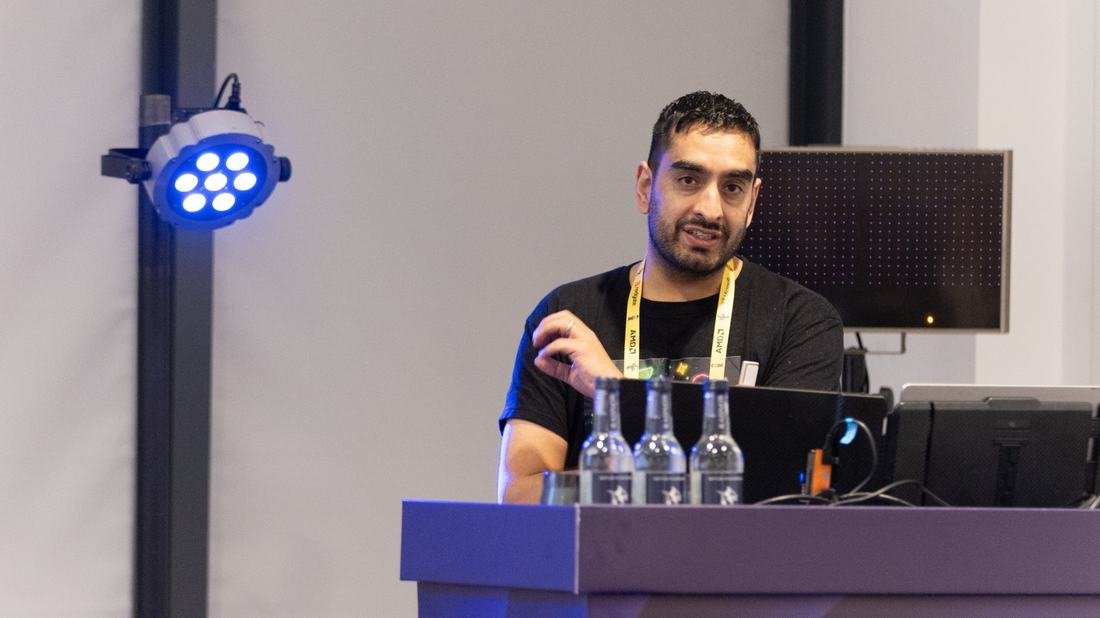
A Chartered Accountant and Microsoft MVP (technology influencer and speaker with direct access to product groups at Microsoft) with an Executive MBA (Hons) and a first-class degree from the London School of Economics.
Currently leads Data & AI strategic projects at Avanade (an Accenture–Microsoft joint venture), focusing on Power BI and Fabric. With 20+ years across Deloitte, KPMG, HSBC, Barclays and Accenture, Rishi combines deep financial expertise with cutting-edge data and AI capability.






“The event was wonderfully presented and segmented. The material was up to date and very relevant to my role.”
 TeodoraSenior Finance Professional · Event attendee (Strategic Intelligence Forum), Q1 2026
“I really enjoyed learning about AI agents, how I can explore and start to implement them in my workplace.”
 OsmanSenior Controller, Group FP&A · Event attendee + Power BI for Finance course, 2026
“Excellent networking. Great to see the level of engagement and the kind of people you were able to attract.”
 Bobby DixitC-Suite Executive · Event attendee (Strategic Intelligence Forum), Q1 2026
You've built the pilot. You still can't say out loud which number in the output you'd actually stake your name on.
You've got three saved prompts. Monday's variance report still starts from the same spreadsheet it always did.
You're expected to be the AI-literate one in the room, and nobody's told you what that's actually supposed to look like.
You could recite five things you've learned about AI this year. You couldn't yet explain your own method for using it.
You have a quiet suspicion someone else at your level has already worked this out, and you just haven't seen it yet.
You bought Fabric. You bought Copilot. The board still asks what you're doing with AI.
Automated month-end and variance workflows generate board-ready Power BI reports, formatted to your standard and delivered straight from Teams. No manual formatting, no copy-paste.
A plain-English Q&A layer over your Fabric data, ask “what's driving the March gap?” and get a trusted answer instantly. One agreed definition of every number, consistent everywhere.
Specific, anchored in real processes, built on real data and real insights. Not another pilot deck or set of vendor promises.
Your own team of agents, business analyst, Power BI developer, data engineer, tester, building on a governed foundation you control. Not rented from a vendor, growing with every process you automate.
Workshops and forums, podcast appearances, conference talks and ICAEW articles - every resource on this site, one card per section.
The quarterly London build workshop and the Strategic Intelligence Forum, with recaps from past sessions.
PodcastFinance x AI Lab, FP&A Unlocked and the GrowCFO Show, on where AI actually lands in finance.
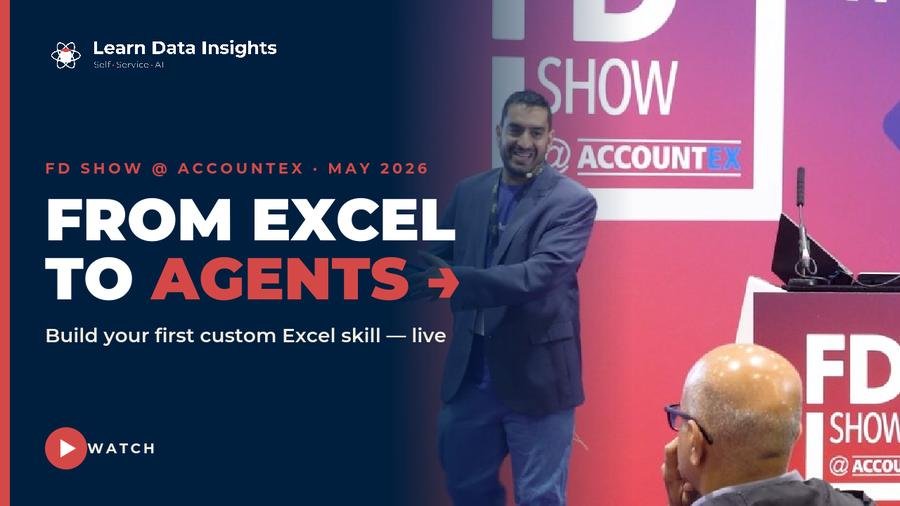
ConferencesAccountex, FD Show, SQLBits and FabCon Europe - the talks and the material behind them.
ICAEWWebinars and written articles for the Institute of Chartered Accountants, on Power BI, Fabric and agentic AI.
Yes, core LDI membership is free, with no time limit and no hidden upsell to unlock the essentials. I'd simply rather have practitioners in the room who genuinely want to build than chase sign-ups.
Yes. There's a dedicated path for non-technical leaders, CFOs and senior commercial roles, who need to understand and commission Self-Service AI without writing a line of code, alongside deeper paths for finance analysts (starting from Excel and Power BI) and data practitioners. All three begin from first principles, so you join at your level.
This is the heart of why Self-Service AI is built on the Microsoft ecosystem. Your data never leaves your own environment: it stays in your organisation's Microsoft tenant and Fabric capacity, in the region you choose, with multi-geo support, so different datasets can be held in different regions to meet local requirements.
Access is governed end to end through Microsoft Entra (identity, conditional access and permissions), so an agent only ever sees what the person using it is allowed to see. You're not shipping your finance data off to a third-party AI provider, the intelligence comes to your data, inside your tenant, under the security and compliance controls you already run.
Microsoft Fabric is needed to run the LDI agent builder itself, though for workshops and demos I can set you up on a temporary account in my tenant. Each course also states exactly which tools and licences it needs, so you always know before you start.
It depends how much context you've built into your agent builder before you start. The quarterly build workshop is designed to get you to a working example in a single day, something your team can actually use, not a slide deck about what you might build. If your diary genuinely has no room for that, it's worth asking what's filling it, since it's often the exact kind of recurring manual work a day like this is meant to claw back.
Consultants build things for you; LDI teaches your team to build for themselves. The quarterly workshop is structured so your team owns every part of the agent they build, the data connections, the logic, the governance rules. The goal is a capability your business controls, not a dependency. Nothing here waits on a vendor or a tooling sign-off either, since the skill is judging where a model's output can be trusted and where a person has to check it, which your organisation needs someone to own regardless of what eventually gets procured.
Yes, and it isn't a you problem. Independent 2026 research puts M365 Copilot adoption below 4 in 10 licensed users, and around 3% of the wider M365 base. The tool isn't the bottleneck, the missing layer is the business context that turns a general assistant into something that knows your chart of accounts and your definitions. That's what the five-layer brain above is for.
Deciding what an AI model can actually see before you type anything to it, the process handbook, the approved definitions, the tools it's allowed to call, and where a human has to sign off. It's different from prompt engineering, which is just wording a single request well. Most agent failures trace back to missing context, not a weak prompt, which is why it's become the core skill in the Finance Forward Deployed Engineer pathway.
Sits inside the business, not in a separate technical function, and turns a real process straight into a working, governed skill. It's one of the fastest-growing roles in tech right now, generally requiring data engineering plus enough domain knowledge to translate a vague business need into something an agent can run. The Finance FDE pathway teaches exactly that, starting from a finance background rather than a computer science one.

Membership unlocks the AI Readiness Roadmap, the workshop register, the courses and the community. One signup. No tiers, no payment. Less than 60 seconds.
No card · no tiers · one email address